

Table of contents
Summary
- Production indicators help evaluate the performance of fashion companies.
- They support more informed and strategic decision-making by providing accurate data.
- Get monthly fashion insights straight to your inbox. Subscribe to our newsletter!
In the fashion industry, where creativity and business go hand in hand, production indicators play a key role in evaluating and improving both creative and commercial processes.
Understanding these indicators provides valuable insights into production efficiency, opening the door to innovation and sustainable growth.
Learn why fashion production indicators matter and how they can be used to optimize every stage, from design to distribution.
Happy reading!



What are production indicators?
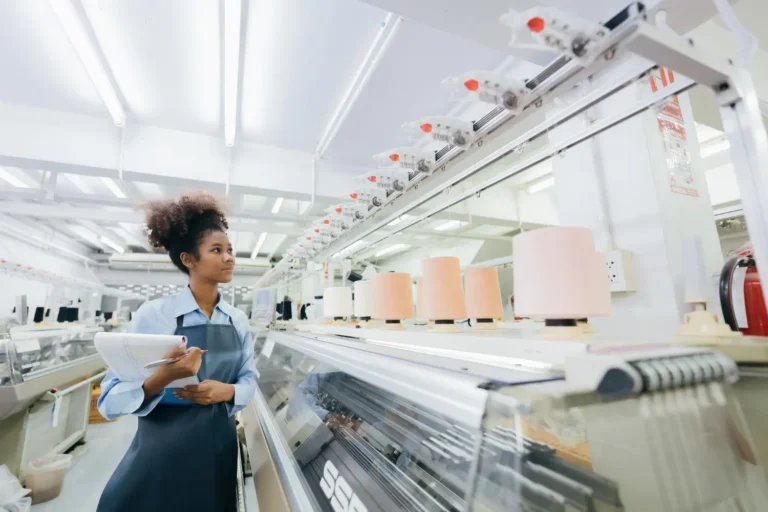
Production indicators are tools used to measure and evaluate a company’s performance in manufacturing its products. They provide insights into different aspects of the production process, such as efficiency, quality, costs, and deadlines.
These indicators typically include metrics like the number of units produced within a given period, defect or rejection rates, average production time per item, and on-time delivery performance.
By tracking these indicators, managers can identify areas that need improvement and take corrective actions to optimize production.
For example, if production time is too long, it may be necessary to review processes or invest in team training.
Similarly, if defect rates are elevated, it becomes essential to investigate the causes and implement measures to reduce them.
Why are production KPIs important for the industry?
Production KPIs help measure operational performance and identify bottlenecks that impact deadlines and costs.
With these indicators, apparel companies gain a clear view of real results and can make decisions based on data rather than assumptions.
They are also essential for increasing production efficiency, reducing waste, and improving product quality.
In fashion, tracking KPIs allows companies to adjust processes and respond to market demands with greater speed and confidence.
Read more: 5 steps to optimize your process of textile production
How do industrial production indicators work?
Production indicators translate factory performance into measurable numbers and percentages. They compare what was planned with what was actually achieved, showing whether targets are being met.
These metrics are monitored continuously and make it possible to anticipate issues before they affect results.
With the support of automated systems like Audaces Isa, companies can monitor data in real time and take action quickly.
Key fashion product performance indicators to start tracking now
By monitoring production and sales indicators, managers can make more informed and strategic decisions to improve overall business performance.
Below are 21 key indicators to track production and sales performance in a fashion company:
1) Number of units produced
This indicator measures the number of units produced within a given period, providing a clear view of productivity.
2) Average production time
It refers to the average time required to produce a single unit. Tracking this indicator helps identify bottlenecks and optimize processes.
3) Production cost

This includes all costs involved in producing each unit, such as raw materials, labor, energy, and overhead. Controlling this cost is essential to ensure profitability.
4) Lost sales
It represents the number of sales opportunities that were not converted. Monitoring this helps identify issues in the sales process and improve conversion rates.
Read more: Uncover the hidden key to successful fashion management
5) Sales volume
It measures the total number of sales within a given period. It is essential for evaluating commercial performance and identifying market trends.
6) Rework rate
It indicates the percentage of items that need to be redone due to sewing, patternmaking, or finishing errors. A high rework rate signals the need for a process or quality control review.
7) Production efficiency
It compares actual production with planned output. It measures how effectively time and resources are used.
Read more: Learn how to improve production and productivity in fashion
8) OEE (Overall Equipment Effectiveness)
This evaluates machine availability, performance, and quality. It’s essential for reducing downtime and increasing productivity.
9) Fabric waste rate
It measures how much material is wasted during cutting. Reducing this KPI is critical for cost savings and sustainability.
10) Productivity per employee
It measures how many units each employee produces within a given period. It helps identify top performers and balance workloads.
11) Defect rate per batch
This indicates the percentage of defective items in each batch. It reveals quality control issues and the need for adjustments.
Looking for an easier way to plan your collections? Download our free resource and simplify your entire planning process!
12) Production lead time
It represents the total time from the start to the completion of production. Reducing it increases speed and competitiveness.
13) Setup time
This is the time required to prepare machines between production batches. Reducing setup time directly increases production capacity and throughput.
14) Machine utilization rate
It shows the percentage of machine usage compared to total available time. It helps balance production capacity.
15) Inventory accuracy
It compares physical inventory with system records. High accuracy ensures better control and prevents disruptions.
16) Sewing productivity index
It evaluates the performance of sewing operators, considering time, quality, and output.
17) On-time delivery rate
This measures the percentage of orders delivered within the agreed deadline. It reflects reliability and customer satisfaction.
Read more: How to improve productive efficiency in textile businesses
18) Absenteeism rate
It indicates employee absences and delays. High rates can negatively impact productivity and workflow.
19) Cutting efficiency
It measures fabric utilization during cutting and spreading, directly impacting material yield and waste levels.
20) Response time to issues
This evaluates how quickly the team identifies and resolves production problems. It reflects overall operational responsiveness.
21) Customer satisfaction
It collects feedback on quality, fit, and finishing. High satisfaction indicates efficiency across the entire production chain.
Examples of productivity indicators in fashion

In the fashion industry, some of the most relevant productivity indicators include:
- Production efficiency: it compares actual time spent versus planned time for each batch.
- Rework rate: it shows the percentage of items redone due to errors.
- OEE: it evaluates machine utilization during production.
- Productivity per employee: it measures individual output.
These indicators help managers optimize resources and improve team performance.
Read more: Enhance productivity in sectors of the textile industry with technology
Why track these indicators daily?
Tracking these indicators daily provides a real-time view of business performance. This means you can quickly detect issues in production or sales and resolve them before they escalate.
It also allows for immediate adjustments to optimize processes and improve efficiency.
By making decisions based on up-to-date data, you ensure your business stays on track to achieve its goals.
Daily monitoring also keeps the entire team aligned and engaged, as everyone has a clear picture of performance and priorities.
How can I manage production indicators?
Managing production indicators requires continuous monitoring, careful data analysis, and alignment across teams.
The first step is to define clear goals and select metrics that truly reflect your business objectives.
Next, it is essential to record data consistently, ideally using systems that centralize information.
With solutions like Audaces Isa, you can track performance across each department and quickly identify where improvements are needed.
Read more: Discover PLM and its benefits for fashion manufacturing
How does technology help you interpret these indicators?
Technology plays a key role in interpreting production indicators.
Specialized management software can automate data collection and analysis, turning numbers into clear charts and reports. Moreover, mobile apps allow access to this data in real time from anywhere.
In addition, Internet of Things (IoT) devices can collect data directly from machines and equipment, offering precise insights into operational performance.
Artificial intelligence and advanced analytics can also identify patterns and trends, helping predict future challenges and opportunities.
Monitor your production indicators in real time with Audaces technology
Audaces Isa
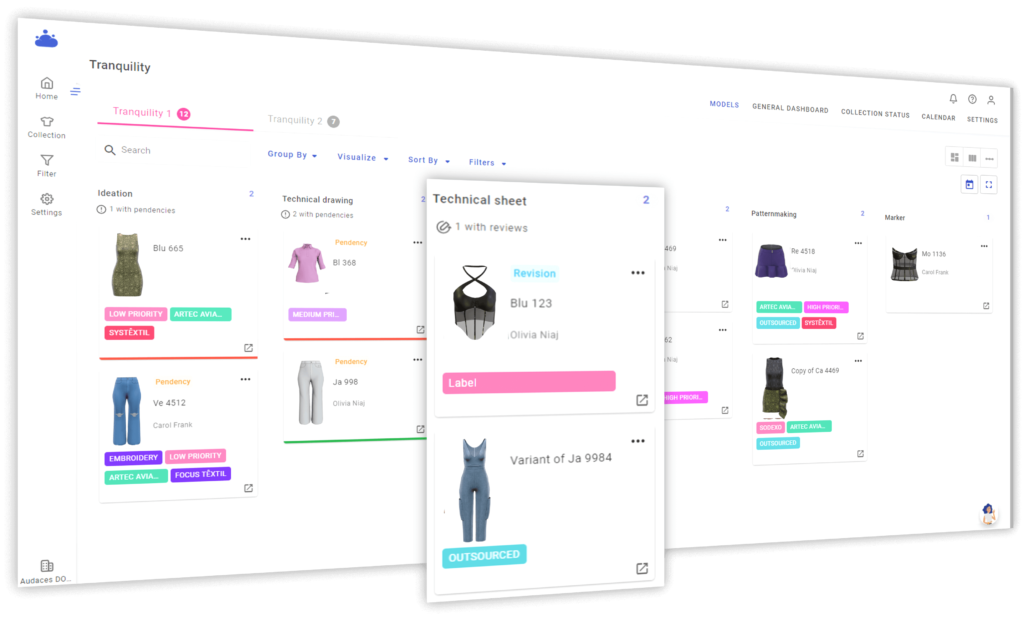
Streamline your workflow, accelerate production, and elevate your brand with Audaces Isa.
This innovative PLM software empowers fashion companies to take control of their entire collection development process. From initial ideas to final products.
Audaces Isa centralizes data and fosters collaboration, leading to more than 50% reduction in product launch time. You can even have real-time access to your collection progress directly from your phone, with the mobile version.
Identify potential issues early, track progress seamlessly, and enable teams to optimize production and quality.
Audaces ICF
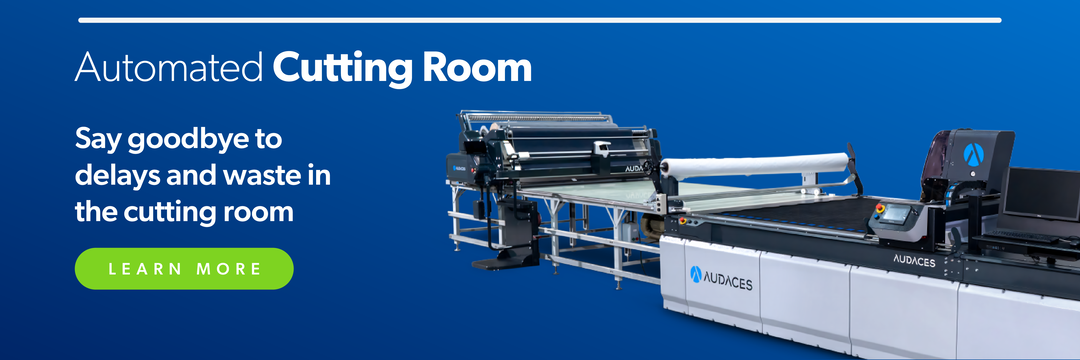
An intelligent technology that connects people and cutting room equipment with high security.
It’s fully digital and focused on data security. It provides the best tools for planning and managing spreading and cutting processes.
In addition to streamlining your workflow, the online platform ensures access for all stakeholders. All information is available in real time via smartphone.
Managers can effortlessly schedule cut orders, specifying details like spreads, layers, cuts, and fabric quantities.
Moreover, Audaces ICF monitors and alerts about differences between planned and actual results, with automatic correction suggestions.
See how Amibo reduced waste and sped up production with Audaces solutions!
Discover Audaces360 and unlock a world of possibilities for fashion design and production. Explore our comprehensive suite of solutions today.
FAQ
Production indicators are tools used to measure and evaluate a company’s performance in manufacturing its products. They provide insights into different aspects of the production process.
Production KPIs help measure operational performance and identify bottlenecks that impact deadlines and costs. With these indicators, apparel companies gain a clear view of real results.
Production indicators translate factory performance into measurable numbers and percentages. They compare what was planned with what was actually achieved, showing whether targets are being met.