


Summary
- Shoe manufacturing brings together several stages to create each shoe model.
- The production process can vary depending on the type of footwear and the factory’s structure.
- Discover how to bring more technology into shoe production with Audaces360 solutions!
Every time someone puts on a pair of shoes, a much longer process sits behind that simple, everyday gesture. Shoe manufacturing brings together several distinct stages to build each model.
A small workshop and an automated factory rarely work the same way. Materials, production volume, and equipment all shape how a company runs its operation.
So how does shoe manufacturing actually happen? This article breaks down the main processes, the materials and machines involved, and factors like production time and cost.
Enjoy the read!
Sumário
What is shoe manufacturing?
Shoe manufacturing is the process of turning a design concept into a finished, wearable shoe. Every pair starts as an idea that has to become pieces capable of fitting a human foot.
That idea passes through several stages, and the exact path depends on the model and the materials chosen. In broad terms, a shoe is made up of an upper (the top portion) and a sole (which forms the bottom).
Precision matters from the very first stage. An incorrect pattern measurement, for example, can create problems once assembly begins.
Read more: Simplify the shoe design process and unlock creativity




What type of company handles shoe manufacturing?
Shoe manufacturing falls under the manufacturing sector, since it transforms raw materials into finished products. Within economic classification systems, it sits inside the broader footwear industry.
According to the World Footwear Yearbook 2026, published by APICCAPS (the Portuguese Footwear Association), the world produced 24.6 billion pairs of shoes in 2025.
Asia accounts for 88.7% of that total, led by China with a 55.6% share and India with 12.2%. Outside Asia, Brazil and Mexico are the only countries that place among the world’s ten largest producers, holding 3.4% and 0.9% of global output respectively.
These figures show how large a manufacturing company can grow within the footwear industry, and they help explain why the sector remains such a significant part of the global economy.
Read more: Unveil the vital role of the textile designer in fashion
What happens inside a footwear factory?
A footwear factory runs through the different stages that turn raw materials into a product ready to reach the consumer. Each stage follows a flow that can shift depending on the type of shoe and the company itself.
Picture a sneaker sitting on a store shelf. Before it got there, every one of its pieces had to be prepared and assembled in the right order.
Different segments can follow different flows entirely. A factory producing athletic sneakers, for instance, may face very different demands than one building leather boots or safety footwear.
Production volume also shapes how the work gets organized. A small factory can look nothing like an operation built to produce thousands of pairs a day.
What are the shoe manufacturing processes?
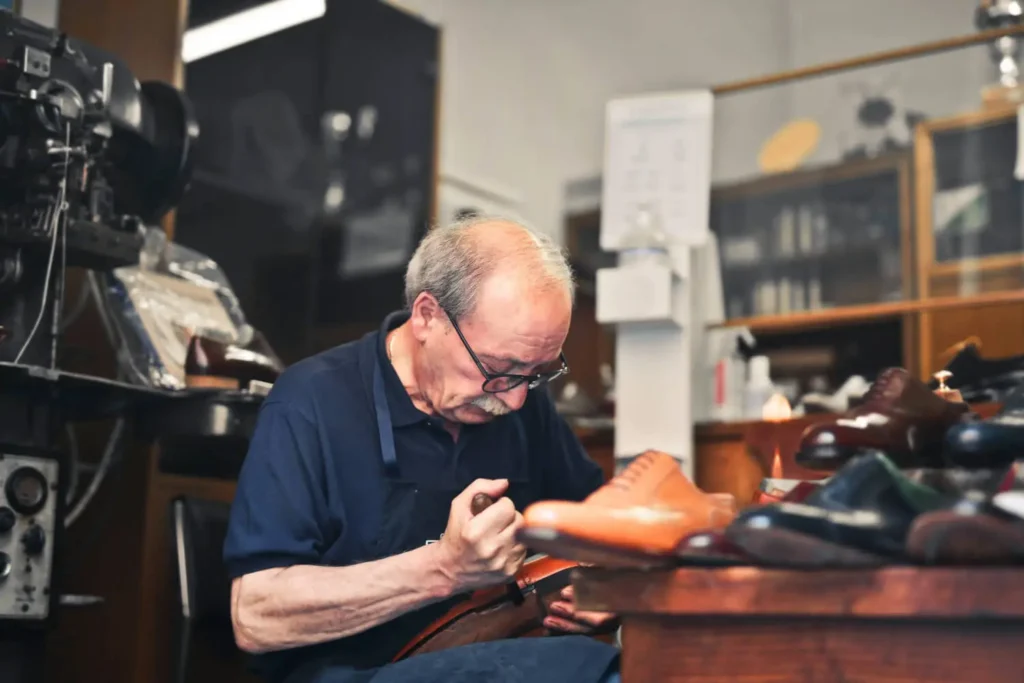
Shoe manufacturing includes several distinct processes. The list below covers the main ones.
Design and pattern making
Design defines how a model looks, while pattern making turns that idea into the pieces used during production. Pattern measurements directly influence both the fit of the shoe and the amount of material needed for each pair.
Read more: Learn how to make a shoe pattern in 7 simple steps
Cutting
During cutting, materials are separated according to the patterns defined for each piece of the shoe. This step can happen manually, using cutting tools, or through automated equipment that follows digitized patterns.
Precision is essential here. A piece cut with the wrong measurements can throw off the fit during stitching and assembly.
Joining and stitching
Before stitching begins, cut pieces get organized by model and size. Guides may also be marked to indicate where the stitching should run, keeping each piece properly positioned.
The pieces are then joined using sewing machines built specifically for footwear, which adapt the stitch to the material.
Certain joints on some models still have to be done by hand, particularly when working with leather.
Assembly and bonding
At this stage, the upper is placed over a last to take on the shape of the model. The sole is then fixed in place, and the surface is prepared before adhesive is applied.
Bonding requires clean, properly prepared surfaces. In some processes, the adhesive is activated with heat before the parts are joined, ensuring a secure bond.
Sole attachment and finishing
Once the shoe structure is ready, the sole is attached using the method defined for that model. The bond needs to be firm and properly aligned to avoid problems during use.
From there, the pair moves through final finishing: cleaning, checking details, and preparing packaging.
What is needed to manufacture footwear?
Manufacturing footwear requires the right resources and trained professionals at every stage.
The production structure changes depending on the type of shoe and the volume a company plans to manufacture.
Take an athletic footwear factory as an example: it needs to define the model’s patterns, select materials, and have the right machinery for each stage. It also needs professionals who know how to operate that equipment and oversee production.
Everything has to be ready before manufacturing starts. If a material runs short or a machine isn’t available, the entire flow can grind to a halt.
What components make up industrial safety footwear?
Industrial safety footwear can include components designed to reduce specific risks tied to each type of work.
Internationally, under the EN ISO 20345 safety footwear standard, protective footwear must include a toe cap capable of withstanding impact and compression. The standard sets a minimum resistance of 200 joules against impact and 15 kN against compression.
Beyond the toe cap, safety footwear can also include soles resistant to slipping or puncture, depending on the demands of each job.
Key raw materials for footwear production

The raw materials used in footwear manufacturing depend on the product being developed and the part of the shoe where they’re applied. The main ones include:
- Upper: leather, textiles, and synthetic materials
- Lining: textiles, leather, and soft synthetic materials
- Sole: rubber, EVA, polyurethane, and PVC
- Insole: foam, EVA, textiles, and leather
- Laces: cotton, polyester, and synthetic fibers
- Toe cap and reinforcements: synthetic materials, thermoplastics, and other structural components
Read more: Learn how fabric technology applies to fashion design
What is the best material for shoes?
The best material for a shoe depends entirely on how it will be used. A daily walking shoe doesn’t need the same characteristics as a work boot built for a construction site. Each product has different needs.
Leather can be a strong choice for certain models. Textiles tend to work better for designs built around lightness, while synthetic materials open up other possibilities entirely.
That’s why the material choice should start with the end consumer and the intended use of the shoe.
Read more: Discover the best types of fabric for a clothing company
What machines are needed to manufacture footwear?
The machinery required for footwear manufacturing varies by product type and process. Some of the most common equipment includes:
- Cutting machine: cuts pieces according to the model’s patterns
- Sewing machine: joins the different pieces of the shoe
- Lasting machine: shapes the upper over the last
- Bonding machine: fixes the sole and other components in place
- Press: applies pressure to secure the bond between parts
- Finishing machine: handles final adjustments and improves overall presentation
Access the free guide to scale textile production to a world-class level! It covers benchmarking, cost cuts and real case studies.
How long does it take to manufacture a pair of shoes?
Production time varies depending on the type of shoe and the manufacturing method. Manual processes typically take longer than those built around machinery.
In handcrafted production, for example, a single pair can take up to 50 hours, according to a case reported by the Spanish trade publication Modapiel. But the production method isn’t the only factor at play — how the work gets organized can make a real difference too.
A study conducted at a footwear company in Peru looked at the impact of implementing the 5S methodology on production. Before the change, producing a pair took 231 minutes. After implementation, that time dropped to 194 minutes.
How can I launch a shoe manufacturing business?
Launching a shoe manufacturing business starts with a clear proposal, then sizing the operation to match it. Before buying any machinery, it’s worth answering one question: what type of footwear should the business produce?
That answer shapes the space needed and the production structure. It also makes choosing suppliers and materials much easier.
Starting with too broad a catalog can spread resources thin across too many needs. A more focused proposal tends to make the first steps easier.
How much does it cost to set up a small shoe factory?
The cost of setting up a small shoe factory depends on production capacity and the type of footwear a company wants to manufacture. Initial investment can stay more contained when the operation starts small.
That initial investment should also cover the resources needed to launch and sustain the operation through its first few months. The final cost depends on each factory’s specific characteristics.
Here are some of the factors worth considering:
| Factor | Impact on cost |
| Production capacity | Defines the amount of equipment and materials needed |
| Space | Costs shift depending on whether the site is owned or leased |
| Automation | More technology can raise the initial investment |
| Type of footwear | Each product may require different materials and processes |
| Machinery | The amount and type of equipment depends on production volume |
| Labor | Staffing needs vary with production volume |
Steps to build a footwear business from scratch
Turning an idea into a footwear business means building a plan that organizes the operation from day one.
So where should that plan start? Here are the main steps to structure a footwear business:
1) Define the niche and target market
Decide what type of footwear to offer and who the customer will be. Athletic shoes? Children’s footwear? Safety boots? The clearer the proposal, the easier every decision becomes down the line.
2) Build a business plan and budget
Calculate how much capital is needed to start, and how much it will cost to keep the operation running. Include the initial investment alongside the expenses that will show up during the first few months, for a more realistic picture of the capital required.
3) Choose a location and set up the space
The space needs to let work flow smoothly from one stage to the next. A well-planned layout can cut down on unnecessary movement and make the factory easier to organize.
4) Find reliable suppliers
Suppliers have a direct impact on production continuity. Before signing any agreements, evaluate material quality and delivery capacity: a delay in a single input can stop an entire stage of production.
5) Manage inventory and technology
Tracking inventory makes it clear what materials are available and when they’ll need restocking. Technology can also make operational data easier to access and support better decision-making.
6) Handle legal requirements and licensing
Before production begins, check the requirements that apply to the business and the activity itself. These requirements shift depending on the country and city where the factory will operate.
7) Build a marketing strategy
A strong production line still needs to reach the people interested in the product. Define how the brand should be presented, and where customers typically look for this type of footwear.
How can I run quality control in shoe production?
Quality control in shoe production means verifying that each pair meets the characteristics defined for its model.
These checks can happen throughout manufacturing to catch problems before they reach the finished product. Catching a flaw before moving to the next stage helps avoid rework and wasted materials.
Technology can support this process too. AI-powered solutions now exist that can analyze production data and help flag inconsistencies more automatically.
For safety footwear, this attention to quality matters even more. Products meant to protect the wearer need to meet the specific requirements set by the applicable standard.
Read more: Discover 6 benefits of automatic cutting for fashion manufacturing
Automate your shoe manufacturing with Audaces solutions
Technology can strengthen shoe manufacturing whenever a company needs tighter control over its processes. Digitization cuts down on repetitive tasks and gives teams easier access to information that supports production planning.
It also helps make better use of materials. As production volume grows, even small differences in material consumption can add up to a real impact.
So how does this translate into practice? Audaces builds solutions that support different moments in production, from the initial idea through to cutting.
Audaces360
Audaces360 brings together software covering different stages of the fashion and footwear industry, from developing and preparing models to managing production information. It centralizes processes and makes overall operations easier to control.
For a footwear factory, these tools can help organize daily work and connect information across every team involved in production.
Discover what Audaces360 can do for a footwear business.
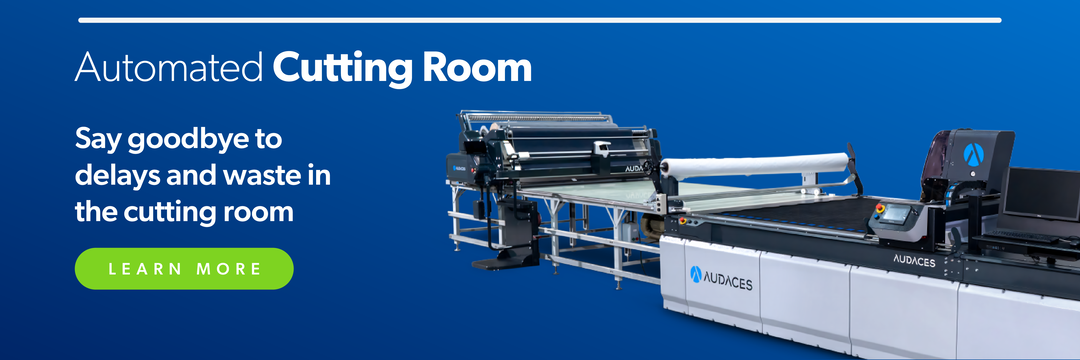
Audaces Cutting Room
Audaces Cutting Room brings together machinery built to optimize material cutting. Its equipment is designed for precision and for getting the most out of the materials used in production.
Learn more about Audaces Cutting Room here!
FAQ
The main processes include design and pattern making, cutting, joining and stitching, assembly, bonding, sole attachment, and finishing.
Shoe manufacturing belongs to the manufacturing sector, since it produces goods from a range of raw materials.
Safety footwear can include components such as protective toe caps, resistant soles, and other protective materials, depending on the type of risk the wearer faces.