

Summary
- Fashion brands operating on 2–3 week development cycles are setting a new competitive standard.
- Long production cycles result from manual steps, fragmented information, and a heavy reliance on physical prototypes that slow down every stage of development.
- Get monthly fashion insights straight to your inbox. Subscribe to our newsletter!
The fashion industry has a speed problem — and it is not about runway trends. Brands like Zara have benchmarked the development cycle at two to three weeks, and most manufacturers are still running on timelines measured in months. The gap is real, and it is growing.
Behind it lie manual pattern work, approvals tied to physical samples, and product information scattered across departments that rarely communicate in real time. Each bottleneck adds days to a process that should be moving forward.
This article breaks down where time is actually being lost, how digital integration changes the equation, and what the shift from long cycles to short ones looks like in practice.
Happy reading!
Sumário
What does agile manufacturing mean in the fashion industry?
Agile manufacturing in fashion refers to the ability to move from a design brief to a production-ready style in the shortest time possible. It’s a production philosophy borrowed from software and applied to physical goods, where speed and accuracy are not trade-offs but complementary outcomes of a well-integrated process.
In practical terms, an agile fashion manufacturer can respond to a collection change, a new client brief, or a last-minute fit correction without the delay cascading through the entire production calendar.
The benchmark most often cited in the industry is Zara’s two-to-three week development cycle, a standard that has redefined what responsiveness means at scale. For manufacturers aiming to serve fast-moving global brands, matching that rhythm is no longer a differentiator. It is a requirement.

Why do most manufacturers still operate on long cycles?
Most fashion manufacturers were not built for speed. They were built for volume, with workflows designed around batch processes, physical handoffs, and sequential approvals.
That model worked when lead times were measured in seasons. It struggles when clients expect turnaround in weeks.
The inefficiencies are not always visible as waste. They are embedded in the standard operating procedure: in the way teams communicate, in how patterns are developed and approved, and in the role that physical prototypes play at every stage of the process.
Three factors stand out as the most consistent sources of delay:
Manual steps that consume time without adding value
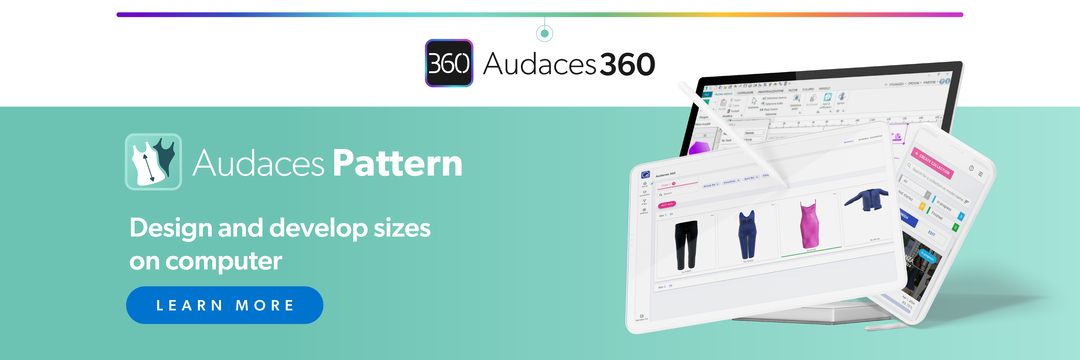
Pattern grading done by hand, measurements transferred between documents, and corrections applied individually to each size. These are steps that consume skilled labor time on tasks that software can handle in a fraction of the time.
When pattern makers spend hours on work that could be automated, that time is not available for the judgment-intensive work that actually requires expertise.
Manual processes also introduce variability. Each person applies slightly different logic, which means quality control has to compensate downstream.
Read more: How does a digitizing board improve pattern making?
Fragmented information between design, pattern making and production
In many manufacturing operations, design and pattern making work from different versions of the same brief.
A fit comment made during a review meeting may never reach the pattern room in writing. A technical specification updated in one department may not be reflected in the production file for days. This fragmentation is not a people problem. It’s a systems problem. When information lives in disconnected tools, synchronization depends on manual effort, and manual effort creates lag.
Read more: Discover PLM and its benefits for fashion manufacturing
The cost of physical prototyping in development time
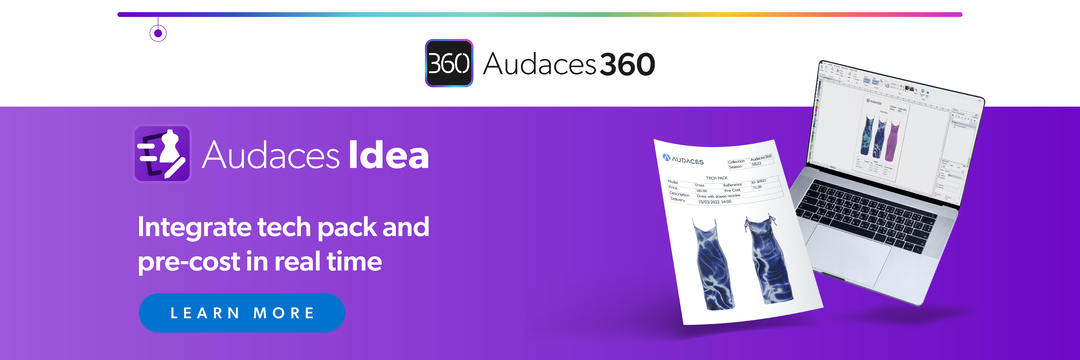
The physical prototype is one of the most expensive steps in fashion development — not just in material and labor, but in calendar time. A sample takes days to produce, requires physical presence to evaluate, and often reveals fit issues that send the garment back for another round of corrections.
For a manufacturer running multiple collections simultaneously, the sample room becomes a bottleneck that the rest of the process waits on.
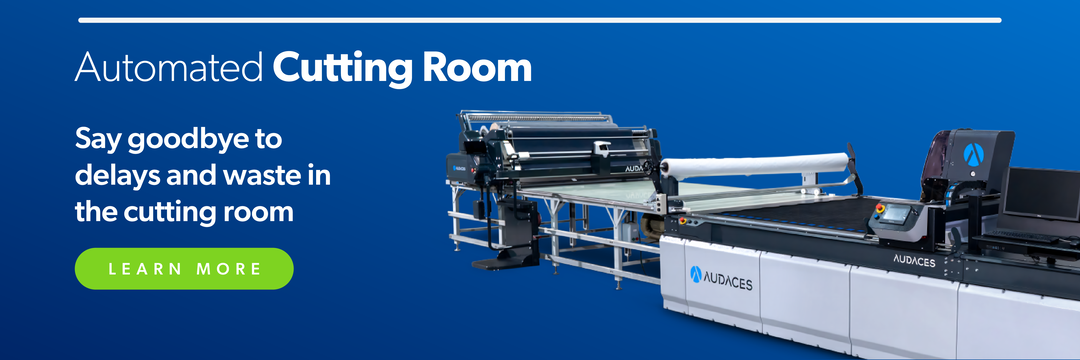
Reducing dependence on physical prototypes (through 3D simulation, digital fit review and virtual approvals) is one of the highest-impact changes a manufacturer can make to cycle time.
Read more: Why simulate the 3D fit of garments before production?
How does digital integration shorten the cycle without compromising quality?
The answer is not faster people. It is fewer handoffs, less rework, and information that moves through the development process automatically rather than manually.
When design, pattern making, and production operate inside a connected digital environment, the time lost between stages shrinks dramatically.
These four changes drive most of that gain.
Information flows in real time
When a designer updates a specification, the change is immediately available to the pattern maker.
When a pattern maker completes a size set, the production team can begin planning without waiting for a file transfer. Real-time information flow does not eliminate the need for human review, it eliminates the wait between human decisions.
That distinction matters: the goal is not to remove expertise from the process but to remove the friction that slows expertise down.
Less rework during development
Rework is the single largest hidden cost in fashion development. A pattern correction that requires rebuilding a graded size set, or a fit issue discovered at the sample stage that forces a technical specification review — these are not exceptions.
They are regular events in a disconnected workflow. When pattern data, grading logic, and technical specifications are linked within the same system, a correction made at one stage propagates automatically. The team reviews once and moves forward.
More standardization and control
When grading rules, seam allowances, and construction specifications are stored in a shared digital environment rather than in individual files or institutional memory, every team member works from the same foundation.
Standardization reduces the number of decisions that need to be made (and re-made) at each stage of development.
Read more: 21 fashion product performance indicators you should track
Faster and more reliable approvals
Approvals slow down when people making decisions do not have the information they need in front of them.
A fit review that requires scheduling a physical sample presentation, coordinating calendars across locations, and waiting for the sample to travel… that process can take two weeks on its own. Digital fit review, virtual prototyping, and shared markup tools allow approvals to happen asynchronously, with annotated feedback that goes directly back into the development file.
The cycle moves forward without waiting for the room to be available.
What changes in operations when the cycle shrinks from months to weeks?
Shortening the development cycle changes more than the calendar. It changes the rhythm of the entire operation.
Planning horizons compress. Teams develop the capacity to run more concurrent collections without proportionally increasing headcount. Client relationships shift from transactional to collaborative, because the manufacturer can respond to input during the process rather than presenting finished work for approval at the end.
The operational changes are also visible in how risk is managed. A manufacturer running 12-week cycles carries a significant amount of uncertainty across that window. Market conditions change, client priorities shift, and design decisions made at week one may look different by week twelve.
A manufacturer running 3-week cycles operates with a much shorter exposure window. Errors are caught sooner, corrections cost less, and the gap between what the client wanted and what gets produced narrows.
That shift requires investment — in technology, in process redesign, and in training. But for manufacturers positioned to serve global brands, the return on that investment is measured in contracts, not just efficiency metrics.
Read more: Guide to production management for garment manufacturers
Your business can produce more, spend less, and deliver ahead of schedule. Get your free guide and discover how the world’s top textile businesses do it!
How can Audaces help accelerate fashion development?
The transition from long development cycles to agile ones requires tools that are built for integration.
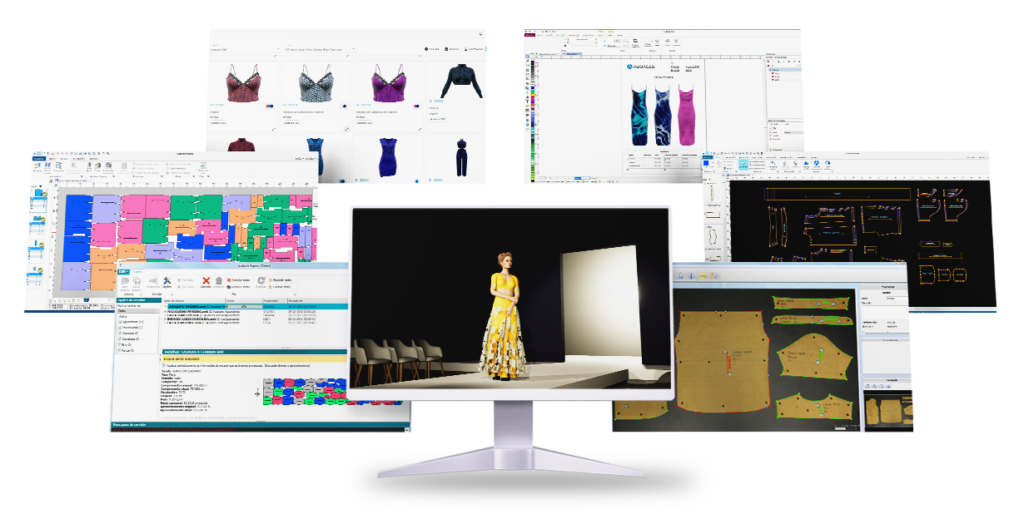
Audaces360 connects the full development workflow inside a single environment, from concept and technical design through pattern making, grading, marker planning, and production output.
Because all stages operate within the same platform, information created at one step is immediately available at the next. A pattern change made in Audaces Pattern updates the graded size set automatically. A marker generated in Audaces Marker draws directly from the approved technical file.
The result is a development process where the time between stages shrinks not because teams are working faster, but because the system stops introducing artificial delays.
Audaces Isa, the Fashion PLM embedded in the platform, manages collection information in a single shared repository. Teams in design, product development, and production access the same data without version conflicts or manual synchronization.
That shared foundation is what makes parallel workflows possible, and what allows manufacturers to run multiple collections simultaneously without losing control.
Read more: How fashion design software cuts costs and speeds production
Take your development cycles from months to weeks with Audaces360
Agile manufacturing in fashion is not a future capability. The manufacturers serving the fastest brands in the world are operating that way now, with integrated digital workflows, reduced dependence on physical prototyping, and development cycles measured in weeks rather than months.
The gap between where most manufacturers are and where the market is heading is real. So is the path to closing it. Audaces360 provides the integrated environment that makes agile manufacturing achievable, connecting every stage of the development process so that speed and technical quality reinforce each other rather than compete.
Ready to see what a shorter cycle looks like for your operation?
Discover Audaces solutions and take your production precision to the next level. Explore our complete suite of solutions today!
FAQ
Agile manufacturing in fashion refers to the ability to move from a design brief to a production-ready style in the shortest time possible, without losing control over fit, quality, or technical specifications.
By reducing handoffs, eliminating rework, and allowing information to move through the process automatically.
Planning horizons compress, teams can run more concurrent collections, and client relationships become more collaborative.