

Summary
- Laser cut fabric delivers high cutting precision for industrial garment production.
- This technology reduces material waste and improves consistency across batches.
- Get monthly industry insights straight to your inbox. Subscribe to our newsletter!
Laser cut fabric has become an important topic for manufacturers seeking more precision and efficiency on the production floor. Instead of using blades or dies, this method relies on a laser beam to cut fabric with extreme accuracy.
For business owners, deciding whether laser cut fabric suits the business depends on some factor. They can include production volume, fabric mix, and quality expectations.
High-precision designs and complex shapes tend to benefit the most from this technology. On the other hand, investment costs and operational requirements must align with long-term production goals.
With these points in mind, let’s take a closer look at the pros and cons of laser cut fabric in apparel manufacturing. Happy reading!

What is laser cut fabric?
Laser cut fabric refers to textiles cut using a high-precision laser beam instead of mechanical blades. The laser follows a digital cutting path, which allows exact reproduction of shapes and dimensions.
The cutting system works by concentrating heat on a specific area of the fabric. As the laser moves, it melts or vaporizes the fibers along the programmed line.
Because there is no physical contact, the material stays stable during the process.
Software controls every step of the operation. Patterns, markers, and layouts are prepared digitally before cutting begins. This level of control helps manufacturers reduce errors and maintain uniform quality in production.
Laser cut fabric is widely used in apparel manufacturing, technical textiles, and fashion collections with detailed designs. It suits operations that require precision, repeatability, and high-quality finishing, especially in medium to large production runs.
Why use laser cutting for fabric?
To better understand its value in manufacturing, here are the main pros and cons of laser cut fabric:
Pros
Laser cutting offers several advantages for garment and textile manufacturers focused on accuracy, efficiency, and production consistency.
Complex shape cutting
Complex shapes are one of the strongest advantages of laser cutting. The technology handles curves, fine details, and intricate patterns with high precision, even in large-scale production.
Decorative elements, technical garments, and pieces that require perfect alignment benefit the most from this level of control. In these cases, traditional cutting methods often require extra steps or deliver less consistent results.
Since the system follows a digital file, every piece comes out exactly the same. That consistency reduces rework and helps maintain strict design specifications throughout the entire batch.
Read more: 4 reasons you should invest in a cutter room for fashion
Speed
Production speed increases significantly with a laser cutter machine. Once the digital file is ready, the machine runs continuously without manual adjustments or tool changes.
As a result, manufacturers can meet tight deadlines more easily and keep production lines moving. Shorter lead times also make it easier to manage repeat orders and fast-paced collections.
Read more: Benefits of investing in an automatic fabric cutting machine
Versatility

Design changes become much simpler with laser cutting. Instead of stopping production to replace tools or adjust physical setups, operators only need to update the digital file. This speeds up adaptation and reduces downtime on the cutting floor.
Because the process is software-driven, manufacturers can move quickly between different models, sizes, or collections.
Small production runs, customized orders, and frequent design updates become easier to manage without compromising accuracy or consistency.
Laser cutting also supports a wide range of applications within the same operation. From basic components to decorative details and technical pieces, the system adapts to different requirements.
This flexibility allows manufacturers to respond faster to market demands and production changes while keeping workflows efficient and controlled.
Read more: How versatile clothing creates collections customers love
Cons
Despite its benefits, laser cut fabric also presents challenges that manufacturers should consider before adopting the technology.
Limitations with certain fabrics
Laser cutting does not deliver the same results across all fabric types.
Natural fibers, thick materials, or textiles with heavy textures may react unpredictably to heat. Edges can become uneven or visually altered.
For manufacturers working with a wide fabric mix, this limitation requires additional testing before full-scale production.
Read more: Discover the best types of fabric for your clothing company
Risk of fabric burning
Heat is an essential part of the laser cutting process, which introduces the risk of burning or discoloration. Lighter fabrics and heat-sensitive materials tend to show these effects more clearly.
To minimize this issue, operators must carefully adjust speed, power, and focus settings. While effective, this extra calibration adds time and complexity to production setup.
High initial and maintenance costs
Investing in laser cutting technology requires a significant upfront cost. Equipment, software licenses, and facility adaptations can represent a major financial commitment.
Beyond the initial purchase, ongoing maintenance also demands attention. Components such as laser sources, optics, and cooling systems require regular servicing to maintain performance.
Specialized technical support and trained operators further increase operational expenses. For some manufacturers, these costs only make sense when production volume and long-term efficiency gains justify the investment.
Which raw materials are best suited for laser cutting?
Fabrics with uniform fiber structure and controlled melting behavior tend to produce cleaner edges and more consistent results. For this reason, not all textiles respond equally to this technology.
Synthetic materials usually deliver the best performance. When exposed to the laser, these materials melt slightly at the cut edge, which helps seal the fabric and prevent fraying. This characteristic improves finish quality and reduces the need for post-cut handling.
Natural fibers behave differently. Since they burn rather than melt, edges may darken or become brittle, depending on the fabric and laser settings.
While cutting is still possible, testing becomes essential to avoid visual defects or material damage.
In general, fabric thickness, fiber composition, and surface finish all influence cutting quality.
Manufacturers should always evaluate materials before scaling production to ensure the laser settings match both design and quality requirements.
Fabrics best suited for laser cutting include:
- Polyester
- Nylon
- Polyamide
- Polyester blends
- Microfibers
- Technical and performance fabrics
Read more: Uncover the fabric composition chart and the most utilized types
Laser cut fabric vs. blade cutting: which is better?
The answer depends on production goals, material choice, and operational priorities.
Both methods play an important role in apparel manufacturing, but they deliver different results under different conditions.
Laser cutting machines stand out for precision and repeatability. It handles complex shapes, small details, and intricate patterns with ease, making it ideal for designs that demand high accuracy. The digital process also reduces material movement and cutting inconsistencies.
Blade cutting, on the other hand, remains highly versatile across a wide range of fabrics. It performs well on natural fibers, thick materials, and layered cutting, often at a lower initial cost.
For many manufacturers, it continues to be a reliable and familiar solution for cutting fabric and textiles.
In practice, many production environments benefit from combining both technologies.
Laser technology supports detailed and high-precision work, while blade cutting handles volume, material variety, and cost efficiency. The best option depends on how each method aligns with the company’s production strategy.
Discover all the benefits the Audaces Automated Cutting Room can bring to your business! Download our exclusive free guide now.
Automate your production with Audaces Cutting Room!
By embracing cutting-edge technology, garment manufacturers can achieve significant improvements in the production process. From greater design flexibility to enhanced efficiency and reduced costs.
This is where Audaces Cutting Room steps in. Our experts will thoroughly assess your company’s needs and create a comprehensive report.
Then, our team will develop a personalized project to achieve your goals and unlock your company’s full potential.
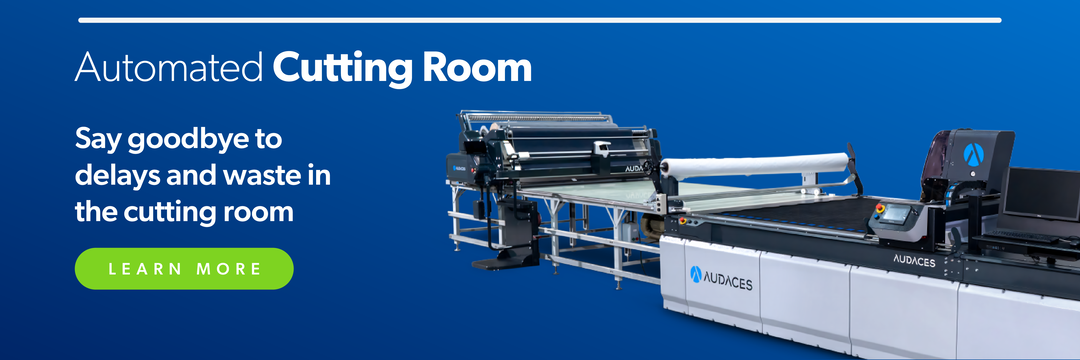
Rely on Audaces’ cutting-edge machinery to automate your production process. Achieve impeccable cuts on curves and details, speeding up your deliveries and minimizing fabric waste through automation.
Success Story
Discover how this denim company adopted Audaces Cutting Room and achieved 13% growth!
By modernizing its cutting process, the company adapted to market changes much faster and gained more control over production. In addition, the brand reduced fabric waste by 5%, reinforcing its commitment to more sustainable manufacturing.
As a result, the company eliminated production delays and improved efficiency across the operation.

Want to achieve these results too? Click here and get in touch with one of our consultants.
FAQ
Laser cut fabric refers to textiles cut using a high-precision laser beam instead of mechanical blades. The laser follows a digital cutting path, which allows exact reproduction of shapes and dimensions.
The benefits include complex shape cutting, speed, and versatility.
The downsides include limitations with certain fabrics, risk of fabric burning, and high initial and maintenance costs.