
Table of contents
Summary
- Industry 4.0 technologies create smarter and more connected fashion operations.
- Fashion companies can gain speed, accuracy, and competitiveness with strategic adoption.
- Get monthly industry insights straight to your inbox. Subscribe to our newsletter!
Fashion businesses face rapid changes in demand, shorter collection cycles, and growing pressure to reduce errors. To help business owners navigate this reality, Industry 4.0 technologies offer tools that provide clarity and control.
They strengthen the connection between creative and technical teams. This way, designers, pattern makers, and production managers access the same data, which makes decision-making clearer.
In the next sections, we explain what Industry 4.0 means, show its main technologies, and share ways to use them in your business.
Happy reading!

What are the Industry 4.0 technologies?
Industry 4.0 technologies represent a new stage of industrial evolution. They combine connectivity, automation, and data intelligence to help companies design, plan, and produce with much more efficiency.
These technologies reshape how decisions happen inside a factory. Now, managers and teams rely on accurate information instead of assumptions, which brings more confidence to every step.
What stands out most is the integration between machines, systems, and people. When everything stays connected, production flows without interruptions and problems appear earlier.
This dynamic creates a smoother manufacturing process and strengthens a brand’s competitive position.
Why is it important to understand Industry 4.0 technologies?
Every year, more factories adopt Industry 4.0 concepts. Owners who understand how these tools work can plan their investments better and avoid outdated methods. Knowledge becomes a strategic advantage in a market that changes quickly.
Awareness also helps businesses stay relevant. New brands enter the industry already using advanced systems, automation, and analytics. Companies that want to grow need to digitally transform their operations to keep up with this new rhythm.
The message is: understanding Industry 4.0 gives teams clarity.
This way, they know where to improve, which technologies match their goals, and how to evolve step by step. This confidence leads to smarter decisions and more consistent results.
How do Industry 4.0 technologies impact apparel production?
Apparel businesses feel the impact of Industry 4.0 on a daily basis. Processes become more precise, fabric waste decreases, and communication between departments turns smoother.
Data also plays a major role. Real-time insights help factories plan materials, organize workflows, and adjust production volumes before issues grow. Brands stay aligned with consumer demand and avoid unnecessary costs.
This evolution transforms the entire production line. Teams gain visibility from design to cutting and sewing. Problems appear sooner, delays decrease, and the factory operates with more stability.
Read more: Key challenges in the garment industry and how to solve them
What are the main Industry 4.0 technologies?
Several tools shape this new era of industry. They work together to support smart manufacturing and help fashion companies improve speed, quality, and decision-making.
Below are the technologies that stand out the most today.
1) Big Data

Data has always existed in factories, but now companies can finally use it to drive decisions.
Big Data gathers information from machines, systems, and customer behavior to reveal what works and what needs improvement.
Companies can benefit from analyzing fabric usage, production times, and recurring errors. These insights uncover hidden costs and help businesses optimize their workflow. Teams stop guessing and start planning with precision.
It also gives companies room to grow. When owners understand their performance in detail, they anticipate challenges and make strategic adjustments before problems escalate.
Read more: 4 textile technologies that are reshaping fashion
2) Machine to Machine
Machine-to-Machine communication (M2M) allows equipment to exchange information without human intervention. When machines “talk” to each other, production gains fluidity because each step happens with the right timing.
In apparel manufacturing, M2M helps identify issues the moment they appear.
A machine that detects slower performance or incorrect settings can alert another system automatically. Teams receive the information instantly and correct the problem before it affects the entire line.
The result is a factory that operates with more consistency and less stress.
3) Digital security
This technology has become essential as factories adopt more connected systems. Every company stores patterns, models, technical sheets, and confidential business information that must remain protected.
A strong security structure keeps this data safe from unauthorized access and cyber threats.
This strongly influences trust. Clients feel more comfortable working with brands that take digital protection seriously.
At the same time, inside the company teams collaborate more freely when they know their work is safe. A secure environment encourages the adoption of new technologies and supports long-term growth.
Read more: Explore the benefits of industrial technology in the fashion sector
4) Systems integration
Systems integration brings all areas of the company into one connected flow. Design, pattern making, production, and management share the same information.
When everyone sees the bigger picture, decisions become faster and more aligned.
Data moves seamlessly between platforms, and teams understand how their tasks affect the next stage. Problems become easier to trace because the entire operation feels unified, not fragmented.
Integrated systems also create the foundation for digital technologies to work at their full potential. Automation becomes easier to implement, reports become more reliable, and production gains a smoother rhythm.
Ready to take your production to the next level? This fashion e-book holds powerful insights! Download it now and unlock new growth opportunities.
5) Robots
They contribute to Industry 4.0 by handling activities that demand repetition, precision, or physical effort. Their presence takes pressure off employees and brings more stability to daily operations.
Teams focus on supervision, quality, and creative problem-solving while robots support the heavy lifting.
In the apparel sector, robotic solutions help in storage areas and packaging. They improve accuracy and reduce the chances of errors caused by fatigue or rushed work.
A factory that combines robotics with real-time monitoring becomes a true smart factory. Machines adjust automatically, systems stay synchronized, and managers gain full visibility of what happens on the floor.
Read more: What is a smart factory and how to become one?
6) Cloud computing
Cloud computing centralizes information and makes it accessible from any device or location.
Teams collaborate more easily because they share the same files, updates, and tools without waiting for manual transfers. Workflows become lighter, and communication feels more natural across departments.
These solutions also improve decision-making by delivering real time data. With information updated instantly, teams adjust production plans, identify bottlenecks, and respond quickly to unexpected challenges.
7) Additive manufacturing
Additive manufacturing, or 3D printing, brings new creative possibilities to the fashion industry.
Designers develop prototypes, accessories, and structural components directly from digital files, speeding up tests and reducing material waste. Ideas move from concept to testing much more quickly.
The technology also supports personalization. Brands create unique pieces, limited collections, or custom-fit elements without relying on large production runs.
This flexibility opens the door to niche markets and adds value to collections.
8) Augmented reality

AR is reshaping the retail experience by bringing digital elements into the shopping journey. Now, shoppers can visualize how clothes will look on them without stepping into a fitting room.
Augmented reality mirrors and mobile try-on apps show garments in real scale. They have the power to help customers explore colors, styles, and combinations in a more confident way.
Read more: Why is augmented reality in fashion a smart business move?
What is the core technology behind Industry 4.0?
There isn’t a single technology that defines Industry 4.0, but connectivity sits at its core.
Modern factories rely on machines, systems, and people exchanging data in real time. However, this only works when everything is connected through strong digital infrastructure.
Networks such as IoT, Wi-Fi 6, 5G, and industrial Ethernet allow information to move quickly and reliably across the entire production chain. Without this foundation, none of the advanced tools used in smart manufacturing would operate at their full potential.
Connectivity becomes powerful when paired with data intelligence. Sensors, machines, and software constantly produce information about performance, quality, and resource consumption.
Companies use this data to automate decisions, detect problems early, and optimize processes with precision.
Cloud platforms and edge computing play a key role here because they make it possible to store, process, and analyze massive volumes of information with high speed and flexibility.
All these elements support a broader goal: integrating the digital and physical worlds.
Read more: Discover how to enhance productivity in the textile business chain
Get access to essential Industry 4.0 technologies with Audaces
Audaces Cutting Room
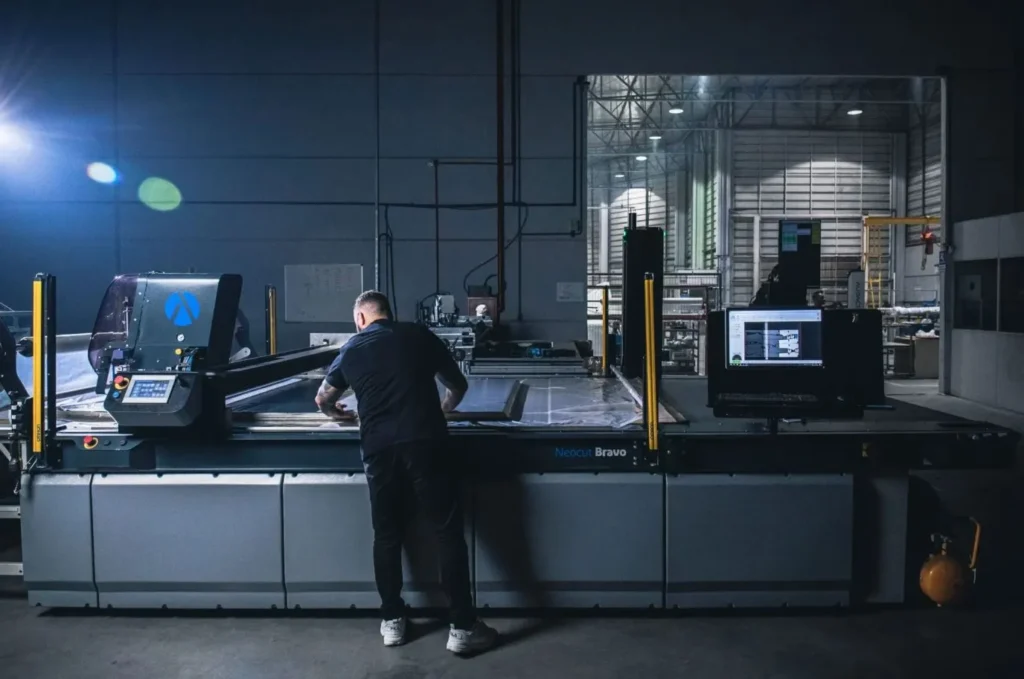
By embracing cutting-edge technology, manufacturers can achieve significant improvements in the production process. From greater design flexibility to enhanced efficiency and reduced costs.
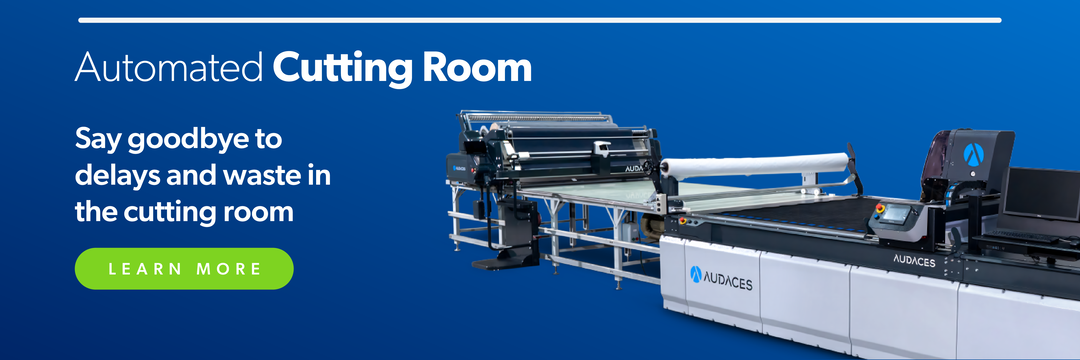
This is where Audaces Cutting Room steps in! Rely on Audaces’ cutting-edge machinery to automate your production process.
Achieve impeccable cuts on curves and details, speeding up your deliveries and minimizing fabric waste through automation.
Audaces360
Audaces360 integrates cutting-edge digital innovations to optimize workflows in the textile and apparel industry.
It caters to companies of all sizes and types, offering the flexibility to scale with your business needs.
All solutions were carefully developed to address the specific challenges of the field. They streamline the design and production processes, saving valuable time and resources.
The platform boasts a comprehensive range of functionalities, including pattern making, marking, collection management, vector drawing, and 3D creation.
In addition, a fashion Artificial Intelligence to assist you along the way.
Discover Audaces solutions and unlock a world of possibilities from fashion design to sales. Explore our comprehensive suite of solutions today!
FAQ
They combine connectivity, automation, and data intelligence to help companies design, plan, and produce with much more efficiency.
Owners who understand how these tools work can plan their investments better and avoid outdated methods. Knowledge becomes a strategic advantage in a market that changes quickly.
Processes become more precise, fabric waste decreases, and communication between departments turns smoother.