


Table of contents
Summary
- Industrial precision in pattern grading is what allows brands to maintain fit consistency across all sizes.
- As production scales up, the risk of grading inconsistencies grows, and so does the cost of fixing them.
- Get monthly fashion insights straight to your inbox. Subscribe to our newsletter!
For mid-size and large manufacturers, pattern grading is not just a technical step. It’s a strategic decision that directly affects product quality, production efficiency, and profit margins.
When your team grades patterns with industrial precision, every size in a range reflects the same fit intention as the original. When it does not, problems compound quietly until they show up as returns, rework, or inconsistent garments on the production floor.
In this article, we explore how precision in the grading process protects your brand quality at scale, what you should check before approving a size range for cutting, and how automation resolves the bottlenecks that growing operations face.
Happy reading!





How does pattern grading improve garment accuracy?
Pattern grading is the process of scaling a base pattern up or down to create a complete size range. Done correctly, it preserves the proportions, balance, and fit of the original design across every size produced.
In industrial environments, this precision becomes essential. A small deviation in a single grading rule can affect dozens or hundreds of pieces before anyone notices.
The garment may look right on paper but behave differently on the body, a problem that often only surfaces during fittings or, worse, after bulk production has already begun.
What distinguishes industrial-grade grading from manual or informal approaches is the consistent application of well-defined rules throughout the entire size range. Each pattern point shifts according to controlled increments that account for how the human body actually changes between sizes, not just in circumference, but in proportions, height, and posture.
This level of control is what allows a brand to maintain its identity across a size range. The garment a customer tries in a size S should feel as intentional and well-fitted as the one in a size XL.
Why does production volume increase the risk of grading inconsistency?

The larger the operation, the more opportunities exist for errors to multiply. What works for a small production run can become a source of real financial risk at scale.
Three main factors amplify this risk as volume grows:
A large grading range
When a size range spans many sizes, from XS to XXL for example, small grading deviations accumulate across increments. A difference that is barely noticeable between two adjacent sizes can become a significant fit problem at the extremes of the range.
This is especially critical in categories like pants, fitted tops, and structured jackets, where body proportions change non-linearly and grade rules need to reflect that complexity.
Differences between fabrics and base blocks
Not all fabrics behave the same way during production, and grading rules developed for one material do not always translate directly to another. A pattern graded for a structured woven may produce inconsistent results when applied to a stretch knit.
Similarly, base blocks used across multiple collections may carry forward grading assumptions that no longer match the current design intent.
Using outdated or incorrect blocks at scale multiplies the problem across every size and every unit produced.
Read more: 5 base pattern designs you need to save today
Deadline pressure
In large operations, time pressure often leads to shortcuts in the validation process.
Teams send size range files to the cutting room without completing the review, and errors that could have been corrected in minutes become production problems that take hours or days to resolve.
At scale, the cost of a grading error is not just a single garment. It can affect an entire production batch, delay deliveries, and put strain on relationships with retail partners.
What should I check before approving a size range for cutting?
Skipping validation before sending a size range to the cutting room is one of the most common and costly mistakes in industrial garment production.
Before any graded set moves forward, three areas deserve close attention.
Check proportions, ease, and garment balance
Evaluate each graded size not just for measurements, but for overall balance. The grain line must remain consistent, the silhouette should follow the original design intent, and ease allowances must be adequate for the intended fit at each size.
A size range may be technically correct in its increment values and still produce garments that feel wrong, because proportions and balance were not verified as a whole.
Read more: The most common types of hems used in fashion manufacturing
Review critical construction points
Certain areas of a garment are particularly sensitive to grading decisions. Armholes, crotch curves, waistlines, shoulders, and garment length are where inconsistencies are most likely to affect fit and comfort.
These areas require careful review in each size because they involve curved seams, structural support, or direct contact with the body. A small error at the armhole, for instance, can restrict movement or distort the shoulder line, problems that are immediately noticeable during wear.
Confirm the correct file versions
In operations managing multiple collections simultaneously, file version control is a real risk.
Sending an outdated grading file, or the wrong variant of a pattern block, to the cutting room can have serious consequences.
Before cutting, confirm that the files in use are the final approved versions, that all corrections from previous review rounds have been incorporated, and that there is no risk of confusion between similar pattern names or style codes.
Read more: Everything about CAD software for pattern making in fashion
How does automation solve the pattern grading bottleneck at scale?
Manual grading can deliver good results in smaller operations. But as collections grow and timelines tighten, the limitations of manual processes become increasingly costly.
Automation addresses these bottlenecks directly and consistently.
Standardization of grading rules
When you automate grading, predefined rules apply across the entire size range with no variation between pieces.
Once the grading logic is set, it executes identically every time, eliminating the inconsistencies that come from different technicians applying slightly different interpretations of the same rule.
This standardization is especially valuable in large teams or when grading runs across multiple shifts or production sites.
Read more: How does a digitizing board improve pattern making?
Reduction of human error
Every manual step in grading is a potential point of failure. Automated systems remove this risk by applying grade increments precisely and flagging anomalies before they reach the production floor.
For brands managing hundreds of SKUs across wide size ranges, this reduction in error rate translates directly into fewer rework cycles and lower correction costs.
Faster development cycles
Automated grading compresses what can take hours of manual work into minutes. Technical teams spend less time on repetitive execution and more time reviewing and refining results.
This speed becomes a real competitive advantage during collection launches, when multiple styles need to be graded and validated simultaneously under tight deadlines.
Read more: 6 signs you’re ready to move to 3D prototyping
Better control over fit consistency
Because automated grading applies rules uniformly, fit consistency becomes predictable. The brand’s fit standards are embedded in the grading logic itself, not dependent on the individual skill of whoever is performing the task on a given day.
This is what allows a brand to scale production without scaling its quality control problems.
Capacity to handle larger collections
Larger collections mean more patterns, more sizes, and more opportunities for inconsistencies to emerge.
Automation makes it viable to manage that complexity without proportionally increasing team size or development timelines.
Operations that once had to prioritize which styles received careful grading attention can now apply the same level of precision across the entire collection.
Integration with marker making and cutting
When you grade patterns digitally, the output connects directly to the next stages of production.
Your graded patterns feed into marker making and automated cutting without manual conversion or data rekeying, reducing handoff errors and accelerating the overall production timeline.
This integration is what makes digital grading a strategic asset, not just a technical convenience.
Read more: 6 benefits of system integration in apparel manufacturing
Increase your production precision with Audaces solutions
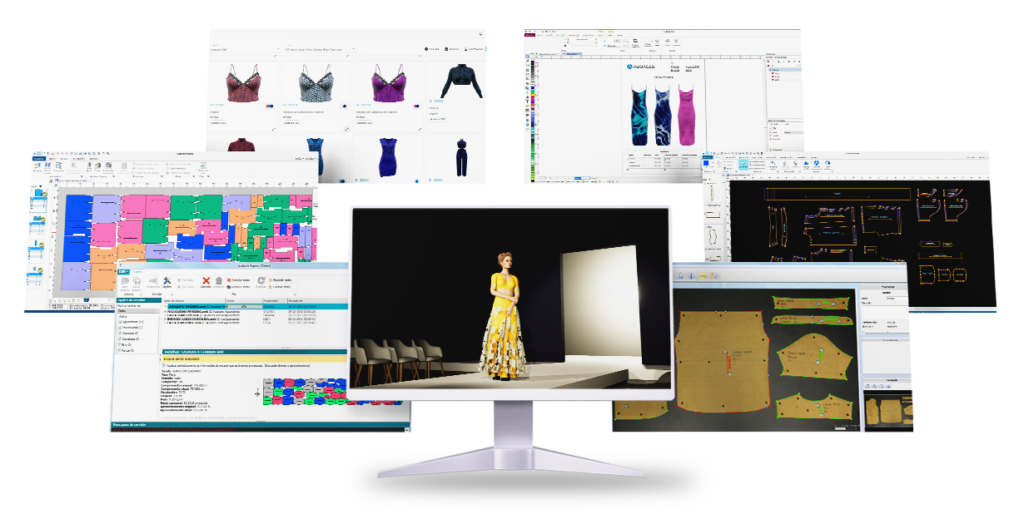
Audaces offers a complete technology ecosystem designed to support garment manufacturers at every stage, from pattern development to cutting room execution.
Audaces360
Audaces360 is a comprehensive digital platform that integrates all stages of garment development into a single connected workflow. It combines pattern making, grading, marker making, collection management, 3D simulation, and AI-assisted design in one environment.
With Audaces360, grading rules apply automatically and consistently across the entire size range. The platform preserves the fit logic defined by the technical team and executes it uniformly, regardless of collection size, production volume, or number of styles in development.
For mid-size and large operations, this means the brand’s fit standard travels intact from the design studio to the production floor, at any scale.
Audaces Cutting Room
Audaces Cutting Room brings industrial precision to the final stages of production.
Once your team completes grading, the files move to the marker making software and are then sent directly to the cutting equipment. This ensures that every piece is cut exactly as designed, with no deviation between units.
By integrating grading with cutting, Audaces eliminates one of the most common sources of inconsistency in high-volume operations: the gap between what the pattern specifies and what the cutter executes.
Our team will thoroughly assess your company’s needs and develop a personalized project to help you reach your goals and unlock your production’s full potential.
Discover Audaces solutions and take your production precision to the next level. Explore our complete suite of solutions today!
FAQ
Pattern grading is the process of scaling a base pattern up or down to create a complete size range. When done with industrial precision, it preserves the proportions, balance, and fit of the original design across every size produced.
Grading errors multiply across every unit produced. In large operations, even small inconsistencies can lead to rework, returns, and delays, all of which directly impact costs and margins.
Automated grading applies standardized rules consistently across the entire size range, eliminates human error, accelerates development cycles, and integrates directly with marker making and cutting. This reduces bottlenecks and ensures fit consistency at any production volume.