

Summary
- Apparel lifecycle management connects design, development, and production into a single, traceable process.
- Digital tools built specifically for fashion give companies real-time visibility, fewer errors, and faster collection launches.
- Get monthly fashion insights straight to your inbox. Subscribe to our newsletter!
A collection moves through more hands than most people outside the industry realize. A sketch becomes a tech pack. The tech pack becomes a pattern, then a sample, then a production order. Each step depends on the one before it, and each handoff is a chance for something to slip.
When that chain runs on spreadsheets, email threads, and physical samples passed between departments, small mistakes compound quickly.
This article looks at why lifecycle management matters, the stages it covers, the challenges manufacturers commonly run into, and the technologies that make a modern approach possible.
Happy reading!
Sumário
Why does apparel lifecycle management matter for fashion manufacturers?
Product development in fashion rarely fails because of one big mistake. It fails through an accumulation of small gaps: a delay here, a miscommunication there, a version nobody flagged as outdated.
Apparel lifecycle management closes those gaps by giving every stage of development a clear owner, a clear status, and a shared source of truth.
The result touches several parts of the operation at once, from how departments collaborate to how quickly a collection reaches the market.
Fewer inefficiencies between departments
Design, product development, and production often operate with their own tools, their own files, and their own timelines. When a change happens in one area, it does not always reach the others in time.
Lifecycle management brings these functions into a connected structure, so updates move automatically instead of depending on someone remembering to send an email.
Teams spend less time reconciling versions and more time actually developing the collection.
Greater visibility into product development
Without a centralized view, managers often only learn about a delay after it has already affected the schedule.
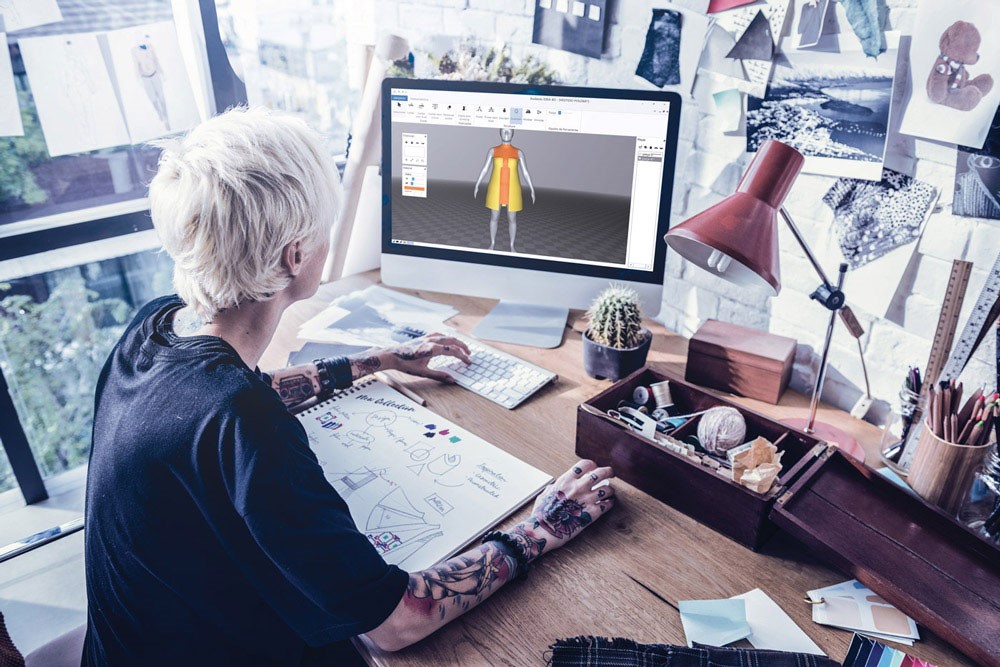
A lifecycle management approach makes the status of every piece visible in real time: what stage it is in, who is responsible, and what is pending approval.
This kind of online collection management breaks down each step of a collection’s life cycle, from conception to final sale, and lets different teams access and share information as it happens.
Faster launch of new collections
Speed to market has become one of the clearest differentiators in fashion. Fast fashion brands have set a benchmark of two to three weeks for a full development cycle, while many manufacturers still operate on timelines measured in months.
Structured lifecycle management closes that gap by removing the handoffs and waiting periods that stretch out development.
Read more: 6 benefits of having an online collection management
Fewer errors and less rework
Most rework does not come from a design flaw. It comes from someone working off an outdated file, or a specification that changed without notice, and a defined process keeps that from happening.
Support for sustainable operational growth
Growth puts pressure on any process that depends on manual coordination.
A manufacturer running two collections might manage fine with spreadsheets and good communication between a handful of people. A manufacturer running eight, across multiple brands or product lines, cannot rely on the same approach without something eventually falling through the cracks.
What are the stages of apparel lifecycle management?
Although details vary between companies, the core stages of apparel lifecycle management follow a consistent logic, from the first idea to the finished garment:
- Concept and research: teams define the direction of a collection based on trends, target audience, and market positioning.
- Design: that direction becomes sketches, colorways, and material choices.
- Technical development: pattern making, grading, and the creation of tech packs that document every specification a garment needs.
- Sampling: the design gets tested against reality before anyone commits to full production.
- Approvals: checkpoints covering fit, materials, and cost, happening at several points along the way rather than just once.
- Production planning: once a style clears those checkpoints, it moves into scheduling and resource allocation.
- Manufacturing: the final stage, where the collection actually gets made.
A well-run lifecycle management process does not treat these as separate silos. It treats them as one continuous flow, where each stage feeds accurate, current data to the next.
Read more: Explore the benefits of industrial technology in the fashion sector
What challenges do fashion manufacturers face in managing the product lifecycle?
Even manufacturers that understand the value of lifecycle management often struggle to put it into practice. The challenges tend to cluster around a few recurring patterns, each one reinforcing the others.
Disconnected teams
When design, development, and production work in isolation, decisions made in one area do not automatically reach the others. A fit correction discussed in a review meeting may never make it into the written specification the pattern room actually uses.
This fragmentation is rarely a people problem; it is a systems problem, since information stored in disconnected tools depends on manual effort to stay synchronized, and manual effort creates lag.
Read more: Agile manufacturing in fashion starts with integration
Manual processes and disconnected workflows
Spreadsheets, printed tech packs, and email approvals still run large parts of product development at many companies, and each of these tools works fine on its own. The trouble starts when none of them talk to each other.
Struggling with delays across your collections? Download our free guide and get practical steps to speed up approvals, reduce rework and keep every stage of development on schedule!
Delays in approvals and decision-making
Approvals that depend on a physical sample or a manager’s availability introduce waiting periods that add up fast.
A style waiting on a signature can sit for days, and a manufacturer running several collections in parallel multiplies that wait many times over, until the entire calendar shifts by weeks nobody planned for.
Difficulty controlling data and versions of products
As a collection develops, specifications change, sometimes several times before a style is ever approved.
Without a system that tracks those changes, teams lose track of which version is current. A material substitution made without documentation, a measurement that changes but does not update everywhere it should: these are the errors that a lack of version control makes almost inevitable.
Balancing speed, quality and production costs
Manufacturers feel constant pressure to move faster, keep quality high, and control costs.
Most production errors in the apparel supply chain come not from technical failures but from communication failures: a measurement misread, a substitution made without documentation, an approval version that never reached the cutting room.
How does digital transformation improve apparel lifecycle management?
Digital transformation changes lifecycle management by replacing scattered, manual coordination with a connected environment where information updates automatically.
Instead of a designer emailing a revised spec and hoping the pattern maker sees it, a digital system reflects the change the moment it happens, and every downstream team works from that same current version.
It saves time and removes an entire category of error that manual processes introduce by default.
The shift also changes how manufacturers make decisions. Real-time dashboards and status tracking replace guesswork about where a collection stands, giving managers the information they need to intervene before a small delay becomes a missed deadline.
The future of apparel is undeniably digital, and companies that adapt to this shift position themselves to remain competitive as the pace of the industry keeps increasing. Companies that treat digital transformation as a foundational investment, rather than an isolated upgrade, tend to see the benefits compound across every collection that follows.
Which technologies support apparel lifecycle management?
Several categories of technology work together to make modern lifecycle management possible.
Product Lifecycle Management (PLM) platforms sit at the center, centralizing collection data, tracking development stages, and giving teams a shared, real-time view of every style in progress.
A Fashion PLM manages the entire lifecycle of an apparel product, tracking every step of creation and development while letting designers, manufacturers, and suppliers access the information they need in one place.
CAD and 3D design tools reduce dependence on physical prototypes, letting teams evaluate fit, drape, and construction digitally before committing to a sample. Meanwhile, digital tech packs replace static documents with living records that update automatically and keep a full history of changes, closing one of the most common sources of production error.
Finally, ERP systems connect product data to the broader business, linking development decisions to costing, inventory, and production planning.
None of these tools replaces the others. Together, they form the infrastructure that turns lifecycle management from a concept into daily practice.
Read more: Discover PLM and its benefits for fashion manufacturing
How can a fashion manufacturer implement an apparel lifecycle management strategy?
Implementation works best as a phased process rather than an all-at-once overhaul.
The first step is mapping the current workflow honestly: where delays happen, which handoffs rely on manual work, and where data tends to get lost or duplicated. That assessment reveals which stages need the most attention first, whether that is approvals, version control, or communication between design and production.
From there, choosing the right technology matters as much as choosing to adopt one at all. A platform built specifically for fashion, with features tailored to collection planning, tech packs, and material management, delivers more value than a generic project management tool adapted to fit.
Training and change management deserve equal weight: a new system only improves the process if teams actually use it consistently, which means involving the people who do the daily work in the rollout, not just the managers approving the investment.
Measuring results, through metrics like development time, rework rate, and on-time delivery, closes the loop and shows where the strategy is working and where it still needs adjustment.
Read more: How tech packs build apparel supply chain transparency
Bring control to product lifecycle management with Audaces Isa
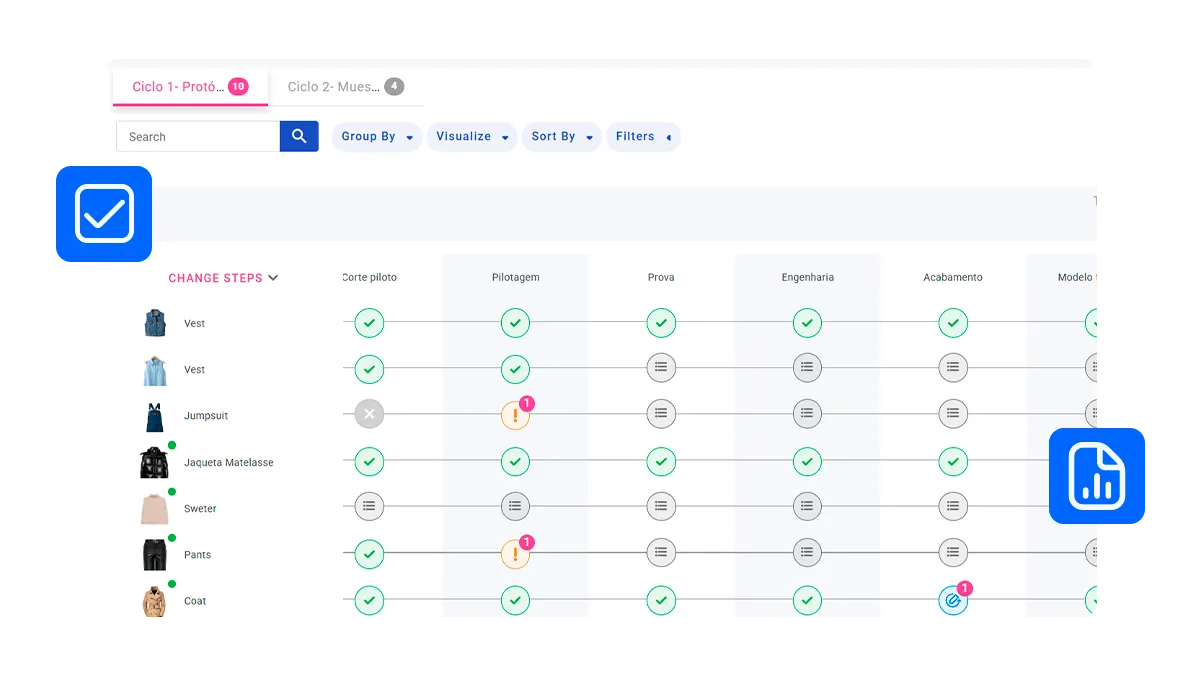
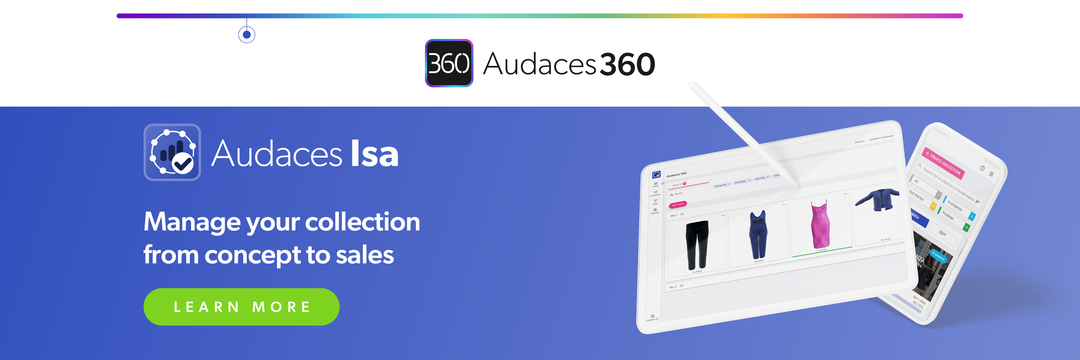
Audaces Isa is a Fashion PLM built specifically for collection management, giving design, development, and production teams a single, shared view of every style from concept through approval.
Instead of chasing updates across spreadsheets and email threads, teams see the real status of each product, with a complete history of every change along the way.
Get a closer look at how Audaces Isa can bring structure to product lifecycle management and support faster, more reliable collection launches.
FAQ
It reduces inefficiencies between departments, improves visibility into product development, and helps manufacturers launch collections faster while cutting down on errors and rework.
Common challenges include disconnected teams, manual and fragmented workflows, delays in approvals, difficulty controlling data and versions, and the constant balancing act between speed, quality, and cost.
PLM platforms, CAD and 3D design tools, digital tech packs, and ERP systems work together to centralize data, reduce reliance on physical prototypes, and connect product development to the wider business.